Asia-Pacific Preparatory Meeting on the Seventieth Session of the Commission on the Status of Women (CSW 70)
Priority Theme: Ensuring and strengthening access to justice for all women and girls, including by promoting inclusive and equitable legal systems, eliminating discriminatory laws, policies, and practices, and addressing structural barriers
Delivered – 29 January 2026, from 9:30Hrs to 15:00Hrs and 30 January 2026, from 9:30Hrs to 15:00Hrs (Thailand Standard Time), United Nations, Conference Room 3, Bangkok, Thailand. (check against delivery)
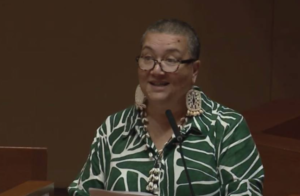
picture rights – Fiji Times
Fijian women’s rights advocate Noelene Nabulivou delivered a strong warning about declining access to justice for women and girls across the Asia-Pacific, citing a global rollback of gender equality and shrinking space for civil society.
Speaking in Bangkok at the Regional Consultation for the Commission on the Status of Women 70 (CSW70), Ms Nabulivou addressed delegates on behalf of Asia and Pacific civil society organisations, including women-led human rights groups, feminist organisations and social movements.
The 70th session of the Commission on the Status of Women (CSW70) will take place from 09 to 20 March 2026, bringing together representatives of Member States, UN entities, and ECOSOC-accredited non-governmental organisations (NGOs) from across the world to discuss the priority theme of ‘ensuring and strengthening access to justice for all women and girls, including by promoting inclusive and equitable legal systems, eliminating discriminatory laws, policies, and practices, and addressing structural barriers’.
Across Asia and the Pacific, women and girls—particularly those from marginalized and excluded communities—continue to face significant obstacles in accessing justice. These include discriminatory legal frameworks, weak enforcement mechanisms, limited legal literacy, economic barriers, digital divides, conflict and displacement, and intersecting forms of discrimination based on gender, disability, ethnicity, age, sexual orientation, and migration status. And those with multiple barriers face compounded injustice.
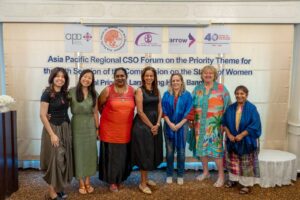
Civil society organisations (CSOs) play a critical role in advancing legal reform, providing survivor-centred services, documenting rights violations, and amplifying the lived experiences of women and girls. Meaningful civil society engagement is therefore essential to shaping regional priorities and strengthening outcomes for CSW 70. In facilitation of this, UN Women ROAP has joined hands with the Asia Pacific CSO Forum Steering Committee comprising organisations such as the Asia Pacific Forum on Women, Law and Development (APWLD), Asia Pacific Alliance for SRHR (APA), Asia Pacific Resource & Research Centre for Women (ARROW), Asia Pacific Women’s Watch (APWW) and Fiji Women’s Rights Movement (FWRM) to organise an Asia Pacific Regional CSO Forum on the Priority Theme of the CSW70 in hybrid format from 27 to 28 January 2026., preceding the Asia-Pacific Regional Preparatory Meeting on CSW 70, This Regional CSO Forum aims to collectively examine and identify actionable regional priorities and put forth recommendations for the CSW70 session and the agreed conclusions on the priority theme.
The Collective Statement from the AP CSO Forum on CSW 70th can be found
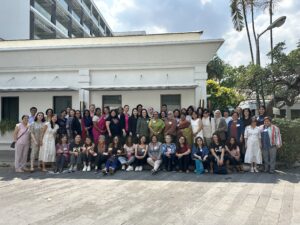
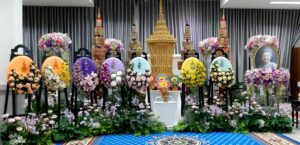
Today APWW and it’s member organisation gather to remember Anne Walker. Anne was an ally, a friend, a mentor, a supporter and guide to many of us on the APWW Steering Committee and to the hundreds of organisations we have represented over the years. She was a women of extraordinary energy, passion and ability who dedicated her life to promoting peace, democracy and social justice.
Anne worked to support many of our members and member organisations over the years some from as early as the World Conferences on Women (Mexico) and her work with Ruth Lechte and the establishment of the YWCA in Fiji.
She had the ability to make the most complicated systems, processes and procedures seem accessible, such was her way of sharing and movement building. Anne served on the Steering Committees and Boards of some of our organisations and was tireless in her support of us.
Meeting annually at the IWTC with Anne was always a pleasure – the small gesture of a cup of tea, or a seat to sit and warm up during the cold winter months, a smile and welcome made the long travel and difficult work so much easier.
Her light and the joy she brought to us all will be missed. Know Anne that you have spread your light far and wide through the many young activists you have mentored and befriended. Some of whom came to work with you at the IWTC. We know you as a friend who was genuinely interested in us as women, as feminists and as someone who was always supportive and happy when we reached our goals.
We thank you Anne for who you were in this world and we thank those who supported you through your journey and send you love in your final resting place.
Developed by the Civil Society Steering Committee (SC), the CSO report highlights priority areas of action to accelerate gender equality and women’s empowerment based on the lived experiences of civil society members in the region. Through this report, we hope to impact the political declaration that will be drafted at the Beijing +30 Ministerial Conference in Bangkok from November 19 to 21.
Based on these consultations that involved 503 participants across 32 countries, the report provides key recommendations for the implementation of the Beijing Declaration and Platform for Action (BPfA) and the Beijing +5 Political Declaration and Outcome (B+5).
Beijing+30 Asia Pacific CSO Virtual Consultations Invitation
APWW as part of the Beijing +30 Civil Society Steering Committee for Asia and the Pacific invites you to join a series of virtual consultations dedicated towards addressing and advancing critical issues related to gender equality and human rights in our Asia-Pacific region.
These virtual consultations will serve as a regional platform for national and regional civil society organisations, networks, coalitions, movements and independent activists to engage in meaningful dialogue, reflect on past achievements, identify current and emerging challenges, and collectively chart a path forward for gender equality and human rights in our region. It will also serve as a roadmap towards advocating for our demands with Member States, UN Institutions, corporations and all other stakeholders. Know more about the consultations:
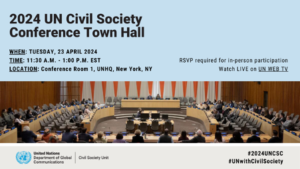
Join the 2024 UN Civil Society Conference Town Hall for updates on the planning and preparation for the Conference and learn how you can become involved!
Watch LIVE on UN WEB TV
#2024UNCSC #WECOMMIT
When: Tuesday, 23 April 2024 Time: 11:30 am – 1:00 pm EST Location: Conference Room 1, UNHQ, New York
This parallel event hosted by Asia Pacific Women’s Watch focuses on the continuing impact on women in a post Covid19 world and, the economic downturn evident in many of the countries in the region. The panel, comprising representatives from the Asia Pacific region, will address issues of economic security of women in a context where households are sliding into poverty across socio-economic divides with women’s unpaid care work intensifying, leaving them and their families vulnerable to negative health outcome. It is now imperative that national as well as regional financial institutions reprioritize investment in sectors (labour, health education) that will strengthen avenues forgender equality. Women are pushing back on patriarchal social norms in collective efforts to highlight alternate strategies that can respond to these critical issues.
CSO AP Forum on CSW 68th Session Bangkok 4-5 Feb 2024
In facilitation this forum, UN Women’s Regional Office for Asia and the Pacific (ROAP) worked collaboratively with the Regional Consultative Engagement Mechanism (RCEM) to host a Civil Society Led Forum from 4th – 5th February, 2024 prior to the ESCAP Asia-Pacific Regional Governmental Consultation on CSW 68th Session held at ESCAP 6 – 7 February 2024.
This event was led by Asia Pacific Forum on Women, Law and Development (APWLD) along with other RCEM Steering Committee members from : Asia Pacific Alliance for SRHR (APA), Asia Pacific Resource & Research Centre for Women (ARROW), Asia Pacific Women Watch (APWW) and Fiji Women’s Rights Movement (FWRM). Over 60 regional and national civil society organisations attended the event both in person and on line.
The regional consultation provided a platform through which ESCAP Member States and stakeholders in Asia and the Pacific assessed and articulated key trends, needs, gaps in legal, policy, and programmatic responses, and good practices in line with the CSW 68 priority theme.
Poverty is a gendered phenomenon, and it intersects with race, ethnicity, age, disability identity, religion, and geographical location, giving rise to distinct forms of discrimination and inequality. It is deeply imbricated and its pervasive impact extends across every facet of women and girls’ lives, influencing the dynamics from individual to family to community, both in public and private spheres. This contributes to and exacerbates existing inequalities. To address these, public institutions must adopt more progressive socio-economic policies and alternative development models to eradicate poverty. The CSW68 priority theme offers a unique opportunity to reassess gendered poverty, and to formulate recommendations that would pave the way for a more inclusive and equitable alternative economic model centred on gender justice, human rights and well-being.
It is essential for civil society to meaningfully engage and contribute to these processes by highlighting issues, challenges, and recommendations related to the CSW68 priority theme.
The CSO Forum on CSW 68 collectively examined and identified actionable regional priorities and put forth recommendations for the ESCAP Asia-Pacific Regional Governmental Consultation on CSW 68th Session held at ESCAP 6 – 7 February 2024.
The statements from the CSO Session were also shared at New York Asia Pacific Caucus meeting and were used to assist members to inform the CSW68 session and the agreed conclusions on the priority theme.
APWW report back and Statements presented from this Forum to the ESCAP Asia Pacific Regional Consultation on CSW 68th Session can be found here:
Asia Pacific Women Watch would like to express our deepest condolences at the passing of Thanpuying Sumalee on 4th April, 2022. It is a great loss for Thai Women Watch and APWW. The world has lost a leading light and great advocate for Gender Equality with her passing . May her soul find peace as she journey’s forth.
Thanpuying Sumalee was one of those rare women who would bring out the best in others, was generous of time and spirit and worked to improve the world through collaboration and kindness. She was one of the founding members of Asia Pacific Women’s Watch (APWW) and at a time when many women were working on national issues, had the foresight to recognise the important role regional organisations played in the battle for women’s rights.
Each of us have special memories of Thanpuying Sumalee an elegant, woman , a gracious host and a great leader of the Asian Women’s Movement. May we hold these memories close as the days move forward.
We made it. Well done to everyone for surviving a second online / hybrid CSW. For many this was a long haul of working through the day, following the negotiations at night and working with their governments to hold them accountable to push a progressive agenda. It’s been a joy working with you all and I hope you’re recovering rapidly from the sleep deprivation.
Parallel Sessions
The Beyond Beijing Committee (Nepal) and APWW successfully presented ‘Achieving Gender Equality and Empowerment of Women and Girls int he context of Climate change’ on Friday March 18th 2022. Moderated by APWW SC Member Ms Shanta Laxmi Shrestha, speakers covered a range of topics from food security, sexual and reproductive rights and addressing the challenges of climate change (interpretation was available in Nepali)
APWW also successfully co-hosted the NGO CSW Asia Pacific Forum Day event held on Saturday 14th March, 2022. This event featured a celebration of women activists from the Asia Pacific Regain along with an interactive panel on the impacts and solutions to some of the issues arising from climate change in this region . A link to the recording of this event can be found here.
A commentary on the Agreed Conclusions
Negotiations for the Agreed Conclusions once more came down to the wire. It sounds like the most difficult negotiations revolved around the climate action paragraphs; negotiations on these paragraphs apparently occurred last, after delegates had already worked through the night, and so were apparently fairly short and to the point. The full version of the final Agreed Conclusions can be found here.
Despite the facilitator’s preference for a brief document, the Agreed Conclusions are about the same length as usual, although there is slightly more content in the preambular paragraphs than in previous years.
Here are some initial thoughts about the outcomes:
The language regarding climate change mitigation and response is weak. It certainly doesn’t go beyond COP26 and in some places doesn’t even reach that standard.
Language on the women, peace and security agenda made it in, but isn’t as strong as we would have liked. The connection between conflict, disaster response and gender was not clarified and the direct reference to Security Council resolution 1325 was deleted.
On the plus side, multiple references to the Sendai Framework for Disaster Risk Reduction in the PPs. (See paras 6, 13, 27 in the PPs and 64(c) and (d) in the OPs.) were included.
Reference to sexual and reproductive health and rights is included in the PPs, a gain, because the PPs set out the acknowledged and accepted context for the subject area. The language in the OPs regarding access to sexual and reproductive health and reproductive rights (para 62(ii)) has reverted to the CSW65 language, which is not as progressive as it could have been.
Unfortunately language about sexuality rights was not accepted.
The language on comprehensive sexuality education was watered down significantly, eventually reverting to CSW65 language. (para 62(ff))
There is a new paragraph specifically on the need to protect women journalists and media professionals from interference, violence and harassment. (Para 62(rr).) There are also several other references to journalists and media workers as important partners and stakeholders. . (Paras 35 and 62(oo).) This is all new and welcome language, and was useful to win here, as it will set a standard for discussing trolling and online harassment against women in public roles under next year’s theme.
There are good reference to oceans and water, which will be important in Small Island Developing States (SIDs countries).
There was push back on the rights of women to own land , key advocacy pushed back on this and the result is a reference to the right to ownership of and control over land and other natural resources in the PPs (para 57), and two reference to eliminate discrimination in relation to ownership of and control over land and other forms of property in the OPs (paras 62 (f) and (h)).
There has been a very obvious battle over including language about women human rights defenders – only two references have survived, down from six in rev.2. (paras 35 and 62(qq).) Language about women environmental defenders has been completely removed.
The United Nations Declaration on the Rights of Indigenous Peoples was included in the PPs and there is also a solid reference to ‘respecting and protecting the traditional and ancestral knowledge, including of indigenous peoples’. (Para 32) and a good stand alone paragraph about Indigenous women in the OPs (para 62(dd) ), along with 10 or so references throughout the text.
The OP paragraph on women and girls with disability includes a reference to the need for disability-inclusive design (para 62(q) ) and there is a reference to integrating a disability-inclusive perspective in policy and laws (para 62(h) ).
There is strong language on women and girls in rural areas throughout the document.
We are apparently only allowed to have three references to multiple and intersecting discrimination in the ACs (paras 19, 25 and 62(dd) ). Down from 5 references in CSW63 and seven in rev.2. (yep – it gets this petty.)
There are strong paras on data and research (paras 56, 62 (ss) and (tt).)
It would be great to hear your thoughts / analysis as you develop your thoughts and workplans with the Agreed Conclusions.






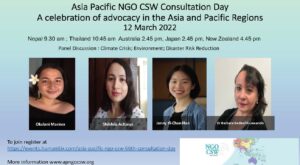 APWW also successfully co-hosted the NGO CSW Asia Pacific Forum Day event held on Saturday 14th March, 2022. This event featured a celebration of women activists from the Asia Pacific Regain along with an interactive panel on the impacts and solutions to some of the issues arising from climate change in this region . A link to the recording of this event can be found